GIGANTIC CONJUGATE DUCTILE SHEAR ZONES IN THE MOON
Dr. Miguel de las Doblas Lavigne, Doctor in Geoscience,CSIC-UCM, retired since 2023, Madrid, Spain, Email:mdoblaslavigne@gmail.com
Abstract
In this paper we describe several huge
ductile crustal-scale shear zones in the Moon (up to 5000 km long and 1000 km
wide), that have never been studied and that appear to be the most gigantic
ones in the solar system. These zones define conjugate sets of NE-dextral and
NW-sinistral shear zones that are indicative of EW compressional stresses once active
in this planet. This tectonic pattern confirms the hypothesis of Melosh (1977,
1980 a,b) who envisioned this type of
global conjugate strike-slip faulting in the Moon. The age of the deformations described
here can be ascribed to a lower Imbrian stage as these structures are partially
transected by a series of later impact structures of known lower Imbrian age
(Mare Orientale and Schrödinger craters), and thus these shear zones would be
the oldest ones in our galaxy. We suggest that these EW compressional stages
might have arisen from the progressive slowing down of the Moon rotation speed,
thus allowing the reshaping of the strongly ellipsoidal Moon towards a more
spherical situation with a less accentuated equatorial bulge. These ideas are
again fully in accordance with the scenario proposed by Melosh (1977, 1980 a,b)
who suggested a generalized deflation of the Moon’s equatorial bulge as a
result of its decreasing rotational speed. The frictional forces associated
with this slowing down process might be responsible for the generation of these
conjugate shear zones, possibly accompanied by a series of EW-trending massive
swarms of magma-feeding dykes (concealed presently) that might have infilled
the Maria lowlands with basaltic flows by upper Imbrian times in the region of
the deflated equatorial bulge. Last, but not least, these gigantic ductile
shear zones might hold some of the most important economic hydrothermal ores in
the whole solar system.
Five
different ductile shear zones have been discovered in the Moon, mainly concentrated
in its visible face, transecting the western half of this planet and bounding
the central Maria lowlands. A series of authors have described similar sets of
conjugate strike-slip systems in the Moon (and other planets), within a so-called
“Lunar Grid System” scenario (Vening-Meinesz, 1947; Strom, 1964; Offield, 1971;
Elston, 1972; McCauley, 1973; Karlstrom, 1974; Whitford-Stark and Fryer, 1975; Cordell
and Strom, 1977; Melosh, 1977, 1979, 1980 a,b; Burt-Pechmann and Melosh, 1979;
Chabot et al., 2000; Whitford-Stark, 1974, 1981). In this sense, it seems
puzzling that several of these authors predicted the existence of planet-scale
sets of conjugate strike-slip faults (NW sinistral and NE dextral), thus fully
in accordance with what we have found in the Moon (Strom, 1964; Offield, 1971;
Elston, 1972; McCauley, 1973; Karlstrom, 1974; Whitford-Stark and Fryer, 1975; Cordell
and Strom, 1977; Melosh, 1977, 1979, 1980 a,b; Burt-Pechmann and Melosh, 1979;
Chabot et al., 2000; Whitford-Stark, 1974, 1981). To our knowledge, no ductile
shear deformation zones with SC-type mylonites (similar to the ones studied
here) have ever been described in the Moon apart from a series of tectonic
“zones” or brittle regional lineaments
between craters Lansberg and Palmieri, tangent to Mare Humorum (Raitala, 1978).
“Structured lineaments” have also been described in Venus (Romeo et al., 2005),
Mars (Márquez et al., 2004) and in the icy crust of Jupiter´s Moon, Europa
(Aydin, 2006). Other authors suggest similar conjugate sets of planet-scale
shear zones which might be related to the rotational characteristics of the
celestial bodies via “global-scale double helix spiral tectonics” (O´Driscoll,
1980, 1981), “helicyclic tectonics” (Wezel, 1988), “global tectonic megacycles
migrating eastwards” (Trurnit, 1991) or
“Earth expansion phenomena” (Pickford, 1996). It is interesting to note
that most moonquakes occur in the visible side of the Moon, in sublinear
regions bounding the Maria lowlands, thus possibly indicating exceptionally
long-lived tectonic reactivation of the shear zones described in our paper.
This work appears to follow some of
the guidelines suggested by Hansen (2000), particularly in the sense that it
contributes to the discovery of the types of operative processes that have
shaped a planet surface, highlighting the fact that tectonic processes are
vital in the geological evolution of these celestial bodies. Furthermore, and
in view of the renewed interest of the NASA on the further exploration of our
planet the present paper fullfills one of the key objectives outlined by this
Agency (NASA, 2006): “Geology objective ID nº mGEO1” aimed at determining the
internal structure and dynamics of the Moon to constrain the origin,
composition, and structure of the Moon and other planetary bodies.
However, we are well aware that the present speculative manuscript might be considered only as an “ideas-paper” which will not be accepted by most “hard-core” specialists on the Moon, as our hypothesis challenges the paradigm of a tectonically-dead satellite. Geometrically-similar features (dual, braided, valleys/ridges, asymmetric, congruent, sigmoidal and linear) than the ones we are describing here as ductile shear zones, have been assigned by other authors to completely different origins: 1) Violent and sudden flows of radial ejecta sheets wrapping around the walls of previous craters and developing flow, slump and avalanche surface characteristics (Orientale basin; Guest and Greeley, 1977); 2) Depositional/deceleration dunes formed in places where laterally flowing base-surge currents (“nuées ardentes”) broke up into turbulent eddies due to the influence of surface topography (Orientale basin; Mutch, 1972); 3) Dual sets of linear and transverse aeolian dunes diverging around topographic obstacles (Earth and Titan; Radebaugh et al., 2009).
Ductile
shear zones in the Moon
Two major families of ductile shear zones can be observed on the Moon, corresponding to two contrasted orientations and senses of movement, thus constituting planet-wide conjugate shear zones: NE/SW dextral and NW/SE sinistral (Fig. 1).

Figure.
1.
Global view of the Moon under visible light highlighting the different
conjugate ductile shear zones discovered in this planet. The visible face of
the Moon is shown with the dashed contour. Craters: Ab: Abdul; Ar: Ariadaeus; Av:
Avogadro; B: Belkovitch; Be: Beer; C: Compton; Gr: Grimaldi; H: Hertzsprung;
MO: Mare Orientale; S: Schickard; Sc: Schrödinger. Shear zones: 1 & 2: SMOH
shear zone; 3: ARBE shear zone; 4: ABAV & BACO shear zones; 5 & 6:
SCMOGR shear zone. Asterisks show the most favourable zones for future
hydrothermal ores targets in the Moon (see text).
Figure.
1.
Global view of the Moon under visible light highlighting the different
conjugate ductile shear zones discovered in this planet. The visible face of
the Moon is shown with the dashed contour. Craters: Ab: Abdul; Ar: Ariadaeus; Av:
Avogadro; B: Belkovitch; Be: Beer; C: Compton; Gr: Grimaldi; H: Hertzsprung;
MO: Mare Orientale; S: Schickard; Sc: Schrödinger. Shear zones: 1 & 2: SMOH
shear zone; 3: ARBE shear zone; 4: ABAV & BACO shear zones; 5 & 6:
SCMOGR shear zone. Asterisks show the most favourable zones for future
hydrothermal ores targets in the Moon (see text).
All pictures shown in this paper have been obtained from the free version of the commercial program Google Moon that download global Moon images from the NASA, using the visible spectrum and the map of elevations.
The first family of ductile shear zones corresponds to a mostly NW/SE trend and the different kinematic indicators clearly visible are consistent with a sinistral strike-slip scenario. Three different segments of this type of shear zones have been observed.
The
most outstanding case corresponds to a 1000 km wide and 2000 km long sinistral
shear zone that follows a NW/SE trend along a series of later impact craters.
In this sense, the name of the shear zone has been chosen according to the
later impact craters that are oriented along the deformational band. This
outstanding case has been named Schickard crater/Mare Orientale/Hertzsprüng
crater (SMOH) shear zone (Figs. 2 and 3). In its southeastern sector (SE of the
Mare Orientale), the shear zones displays the typical kinematic indicators of
ductile shear zones (Fig. 2), i.e., SC mylonitic fabrics, σ and δ deformed
“phenocrysts” (previous craters in our case), fishes, drag effects, pressure
shadows, etc.

Figure
2. Partial view of the SMOH (Schickard crater
(Sc)/ Mare Orientale crater/ Hertzsprung crater) shear zone to the SE of the
Mare Orientale (MO) using the elevations maps. The sinistral strike-slip
character of the shear zone is obvious from the observation of SC-type
deformations, σ- and δ-type deformed craters, elliptical craters (Schiller;
Sch), etc. Note that in this sector this NW/SE shear zone reaches widths up to
1000 km.
It is interesting that the crater
surficial crustal impacts are the ones marking the deformational behaviour of
these shear zones, and they are truly acting as “phenocrysts” belonging to the
inner fabric of mylonitic rocks. In this same area, the memoir of the
corresponding geological map already recognized “the abundance of
irregularly-shaped craters” (Karlstrom, 1974), without further interpretations.
In fact, and as can be seen in figure 2, this shear zone looks strikingly
similar to typical SC-deformed mylonites including the kinematic criteria cited
previously as seen on hand-samples or under the microscope (e.g., Passchier and
Trouw, 1996). This sector of the SMOH shear zone displays the widest
deformational band in the solar system (nearly 1000 km), and in this senses it
constitutes the most gigantic shear zone ever described in this galaxy (typical
ductile shear zones on Earth rarely reach widths greater than 100 km). This
southeastern sector of the SMOH might easily be misleaded with the classical
radial patterns associated to impacts craters as it comes directly from the
Mare Orientale impact crater. In this sense, the existing geological maps of
this SE sector of the shear zone (Offield, 1971; Karlstrom, 1974) wrongly
assume that the NW predominant lineations and valleys are related to the Mare
Orientale ejecta blanket in terms of an Orientale-basin radial sculpture
produced by vertical fault movements. In any case, the uniqueness of this
lineated terrain nearby the Schickart crater has already been recognized in the
geological map of the area (Karlstrom, 1974) in terms of a “complex, sinuous,
intertwining ridge pattern with enclosed elliptical to rectilinear shallow
deposits controlled by curvilinear to straight fractures” (this description
closely ressembles what might be encountered in an SC-type mylonitic terrain
such as the one described in our paper).

Figure 3. Partial view of the NW continuation of the SMOH shear zone reaching the Hertzsprung crater (Hc) to the NW of the Mare Orientale (MO) using the elevations maps. The sinistral strike-slip component of the SMOH shear zone is also highlighted by the abundant SC-type elements, the δ- and σ-type deformed craters, etc. Note the abundant pit crater chains that seem indicative of dilational slip faulting in this sector of the SMOH shear zone. The presence of isolated SC-type deformations and pit chains within the MO and Hc craters indicates that the shearing events are syn/post-kinematic with respect to these pre-Imbrian impact structures.
In its northwestern sector, the SMOH shear zone displays abundant
pit-chains (sensu Wyrick et al., 2004; Ferrill et al., 2004) oriented parallel
to this deformation band (NWSE; Fig. 3), probably indicating that this area
constitutes an extensional/dilational termination of the deformational band. Similar
NW-oriented sinistral ductile shear zones apparently belonging to this same
family can be observed in the central part of the visible face of the Moon to
the S of the Maria sector (Figure 4; Ariadaeus crater/ Beer crater; ARBE shear
zone) and to the east of the central Maria outcrops (Figure 5; the Belkovith
crater/Compton crater; BECO shear zone). In general, we might say that this
type of NW-oriented shear zones clearly influences the geometry of the Maria
lowlands which are bounded by NW/SE accidents.

Figure
4.
Partial view of the ARBE (Aradinaeus
crater/ Beer crater (Be)) shear zone using the elevations maps. The sinistral
strike-slip character of this NW-trending shear zone might be deduced from
different kinematic indicators: SC-type elements, the δ- and σ-type deformed
craters, etc .

Figure 5. Partial view of the ABAV (Abdul crater/ Avogadro crater (Av)) NE-trending dextral shear zone and the BECO (Belkovich crater/Compton crater) NW-trending sinistral shear zone using the elevations maps.. Kinematic indicators
The second family of lunar shear zones is
constituted by two major deformation bands, both oriented NESW and with a
dextral sense of movement. The most outstanding one is constituted by the
Schrödinger crater/ Mare Orientale/ Grimaldi crater (SCMOGR shear zone),
spanning nearly 5000 km (the longest shear zone in the solar system) from the
southwestern part of the visible Moon face towards the NE in its contact with
the Maria lowlands.

Figure
6. Partial view of the SW sector of the SCMOGR
(Schrödinger crater (Sc)/ Mare Orientale crater (MO)/ Grimaldi crater) shear
zone using the elevations maps. Note that this shear zone trends mainly EW to
the S and it then adopts a more NE/SW orientation towards the MO crater. The
dextral strike-slip character of this shear zones might be deduced by the
abundant SC-type criteria, σ- and δ-type deformed craters, drag-effects, etc.
The SCMOGR shear zones in its SW
sector (Fig. 6) shows a nearly EW orientation, progressively changing to the NE
towards a NE/SW generalized trend. The Grimaldi geological map (McCauley, 1973)
clearly shows a predominant NE lineation even if this outstanding structural
element is not further interpreted by this author (Fig. 7). Another segment of
this same shear zone (?) can be observed to the E of the Maria lowlands
constituting the Abdul crater/Avogadro crater (ABAV) shear zone (see Fig. 5).

Figure
7.
Partial view of the NE continuation of the SCMOGR shear zone reaching the
Grimaldi crater (Gr) to the NE of the Mare Orientale (MO) using the elevations
maps. The dextral strike-slip character of this shear zone might be deduced
from a series of kinematic indicators; SC-type elements, the δ- and σ-type
deformed craters, etc.
Discussion
We
might make some guesses regarding the stresses and displacements involved in
the generation of these shear zones. In the case of the SMOH shear zone (Fig.
2), we might observe a nearly perfect elliptical crater (Schiller) located
within this shear zone, and if one assumes an initially circular geometry, then
we might safely deduce a strain ellipse of ellipticity Rs up to 3.0 (Ramsay and
Huber, 1983) acting along this sinistral deformational band, with possible
horizontal displacements (which might be deduced from the inclination of the
strain ellipse) reaching up to 50 kms (Ramsay and Huber, 1983). The elliptical
Schiller crater has been differently interpreted in the literature as a result
of either an oblique impact, two simultaneous impacts or an elongated feature
associated to a NW fault (Offield, 1971).
The
spectacular width of some of these shear zones is indicative of the temperature
of formation of these deformational structures. If one assumes that no erosion
takes place in the Moon, then the width of these shear zones is the original
one on the surface of this planet. From the experience gained from ductile
shear zones on Earth, such widths as 1000 km corresponds to ductile regimes
existent in crustal depths well below 10-15 km, corresponding to ductile
regimes with temperatures of formation up to 200-800 ºC. We should mention that
even if shear zones are thought to be “the most ubiquitous features observed in
planetary surfaces” (Regenauer-Lieb and Yuen, 2003), the usual ideas suggest
that mylonitic shear zones such as the ones described here in the Moon are only
visible to the observer when uplifted and exposed to the surface by erosion
(this is not the case in the Moon as we already argued) and they are thought
to govern the mechanical behaviour of
the strongest part of the lithosphere
below 10-15 km. Furthermore, mylonitic shear zones dissect plates, thus
allowing plate tectonics to develop on the Earth. In this sense, even if the
Moon is presently devoided of this type of global plate tectonics scenario
(O’Neill et al., 2007), one might guess that plate tectonics might have been
active during the early stages of our planet evolution. As occurs on Earth, we
suggest that a special role in this type of deformational bands should be
attributed to the presence of water in nominally anhydrous minerals: the recent
discovery that the early Moon was rich in water (Saal et al., 2008) seems to be
a good confirmation of our hypothesis.
We
might speculate on the possible origin of these conjugate families of ductile
shear zones. The age of formation is constrained by the fact that these
deformational bands are transected and partially synchroneous with later impact
craters of known lower Imbrian age (3800 to 3850 my): in the case of the SMOH
shear zone we might see that this deformational band partially transects the
Mare Orientale crater in its southeastern tip (of known lower Imbrian age). In
the case of the SCMOGR, this shear zone is also supposed to be lower Imbrian in
age as this deformational band is transected in its southwestern sector by the
Schrödinger crater (of lower Imbrian age). If these ages are true, we might be looking at
the oldest known ductile shear zones in the whole solar system. The presence of
NESW dextral and NWSE sinistral conjugate shear zones transecting the whole
visible face of the Moon on a crustal-scale seem indicative of active EW
compressional stresses. We might further speculate that this planet-wide EW
compressional regime might have triggered a series of massive EW-oriented
magma-feeding dyke swarms that might explain the massive basaltic outflows
filling the Maria lowlands (a question presently unresolved) by upper Imbrian
times (3200-3800 my) with what me considered one of the largest LIP in the solar system. We
suggest that it is conceivable that such stresses might have arisen when the
Moon progressively decreased its rotational speed by pre Imbrian times, thus
allowing the reshaping of the Moon elongated ellipsoid (along the equatorial
plane) towards a more sphere-similar geoid. This change in the rotational
behaviour of our planet has been described by many authors and it adequately explains
the existence of planet-wide conjugate systems of ductile shear zones. In this
sense, it seems puzzling that several authors already predicted this type of
“deceleration stresses” of despun planets triggering EW compression and a
series of conjugate sets of strike-slip fractures in different planets (Melosh,
1977, 1980 a,b; Burt-Pechmann and Melosh, 1979; Chabot et al., 2000; Matsuyama
and Nimmo, 2008). This type of planet-wide stresses are highly probable along
equatorial latitudes according to the hypothesis of “membrane stresses” (Turcotte
and Oxburgh, 1974; Oxburgh and Turcotte, 1974) as a result of
rotational-related stresses that are concentrated along the geoid bulge
observed in these sectors of the Earth. It is puzzling that an exactly similar
scenario of a progressively deflating equatorial bulge triggering membrane
stresses as a result of a despinning planet has been suggested by several
authors in order to account for the tectonic evolution of the Earth, the Moon, Mars
and Mercury (Melosh, 1977, 1980 a,b; Burt-Pechmann and Melosh, 1979; Lambeck
and Pullan, 1980; Chabot et al., 2000). Furthermore, Spohn et al. (2001) argued
that the early geological evolution of the Moon might have been characterized
by widespread mantle convection and upwelling and plume tectonics. These equatorial
despun-related deflating stresses might explain the hypothetical EW-trending
massive magma-feeding dyke swarms that we suggest in the present paper,
parallel to the lunar equator that might have filled the Maria lowlands with
the younger basaltic material characteristic of the visible face of the Moon. This
tectonic scenario seems also to be the case for the most famous rift system in
the solar system, also EW-oriented along the martian bulged equator (Vallis
Marineris), even if in that case no basaltic lavas were extruded as the area of
major magmatic activity concentrated further W in the Tharsis region (e.g.,
Olympus Mons).
Last but not least, one of the most interesting possibilities of future lunar exploration programs might be related to the scientific evaluation of potential economic ore deposits in this planet. In fact, one of the lunar exploration objectives of the renewed NASA’s (2006) lunar program is aimed at “characterizing potential resources to understand their potential for lunar resource utilization” (Objective mGEO14). In this sense, we suggest that the Moon might constitute a highly interesting zone for potential gold mineralizations in that it fullfills two basic requisites of the most famous gold mineralizations on Earth: they are genetically associated to ductile shear zones that are invariably hosted by the oldest Archaean rocks (e.g.,; Eisenlohr et al., 1989; Robert and Poulsen, 1997; Weinberg et al., 2004; Micklethwaite, 2007). The gigantic lunar ductile shear zones described in this paper (apparently unique in the solar system) seem perfect in this respect as they are pre-Imbrian in age and they are affecting volcanic rocks which are often the site of interesting ore deposits and hydrothermal mineralizations. In this sense, the nearest/easier lunar possible economic ores might be even more interesting that the already plannified martian ones (Schulke-Makuch et al., 2007) in view of the uniqueness of these gigantic ductile shear zones and the recent discovery of water in the Moon’s interior (Saal et al., 2008). In particular, the intersections between the two families of shear zones or the shear zones and the lower Imbrian impacts-craters/volcanic-edifices or the trantensional sectors of these shear zones, might be highly probable economic-ores targets (see asterisks in Fig. 1). These ideas might be realistic to some degree as shown by the fact that some “theoretical” attempts have been already made at evaluating the potential economic ore deposits of the Moon (McKay and Williams, 1979; Feldman and Franklin, 2004; Gillett and Kuck, 2004).
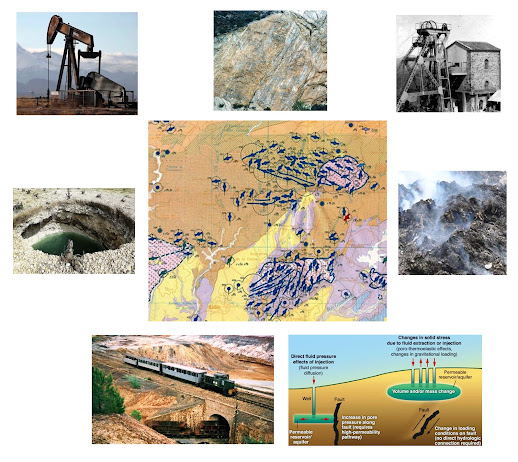
We are here adding a final composite figure of the Google Moon Atlas involving the interpreted main geological and tectonic features that might be useful to further demonstrate our hypothesis of the relevance of tectonics in our satellite.

Figure 8. Final composite
colour figure displaying several geological and tectonic features of the Moon
(downloaded from Google Moon)
Acknowledgements: We thank Google for the pictures downloaded from their free version of Google Moon. We thank José Arroyo, Julia de las Doblas and José María Cebriá for the figures.
References
Aydin, A., 2006. Failure modes of
the lineaments on Jupiter’s moon, Europa: implications for the evolution of its
icy crust. Journal of Structural Geology, 28, 2222-2236.
Burt-Pechmann, J. and Melosh, H.J.
1979. Global fracture patterns of a despun planet: application to Mercury.
Icarus, 38, 243-250.
Chabot, N.L., Hoppa, G.V. and Strom,
R.G., 2000. Analysis of lunar lineaments: Far side and polar mapping. Icarus,
147, 301-308.
Cordell, B.M. and Strom, R.G., 1977.
Global tectonics of Mercury and the Moon. Physics of the Earth and Planetary
Interiors, 15, 146-155.
Eisenlohr, B.N., Groves, D. and
Partington, G.A., 1989. Crustal-scale shear zones and their significance to
Archaean gold mineralization in Western Australia. Mineralium Deposita, 24,
1-8.
Elston, D.P., 1972. Geologic Atlas
of the Moon. Colombo
Quadrangle, I-714 (LAC 79). Scale
1.1,000,000. United
States Geological Survey.
Feldman, S.C. and Franklin, H.A.,
2004. Assessing lunar resources with remote sensing. American Society of Civil
Engineers News, ASCE, New York.
Ferrill, D.A., Wyrick, D.Y., Morris,
A.P., Sims, D.W. and Franklin, N.M. 2004. Dilational fault slip and pit chain
formation on Mars. GSA Today, v.14, p. 4-12.
Gillett, S.L. and Kuck, D.L., 2004.
Extraterrestrial resources. A perspective from terrestrial economic geology. American
Society of Civil Engineers News, ASCE, New York.
Guest, J.E. and Greeley, R., 1977.
Geology of the Moon. Wykeham Publications (London) Ltd, 235 pp.
Hansen, V.L. 2000, Geologic mapping
of tectonic planets. Earth and Planetary Science Letters, v.176, p. 527-542.
Karlstrom, T.N.V. 1974. Geologic
Atlas of the Moon. Schickard Quadrangle, I-823 (LAC 110). Scale 1.1,000,000.
United States Geological Survey.
Lambeck, K. and Pullan, S., 1980.
The lunar fossil bulge hypothesis revisited. Physics of the Earth and Planetary
Interiors, 22, 29-35.
Lammlein, D.R. 1977. Lunar
seismicity and tectonics. Physics of the Earth and Planetary Interiors.
Márquez,
A., Fernández, C., Anguita, F., Farelo, A., Anguita, J. and De-La-Casa, M.A.,
2004. New evidence for a
volcanically, tectonically, and climatically active Mars. Icarus, 172, 573-581.
Matsuyama, I. and Nimmo, F., 2008.
Tectonic patterns on reoriented and despun planetary bodies. Icarus, 195,
459-473.
McCauley, J.F. 1973. Geologic Atlas
of the Moon. Grimaldi Quadrangle, I-740 (LAC 74). Scale 1.1,000,000. United
States Geological Survey.
McKay, D.S. and Williams, R.J., 1979. Geologic assessment of
potential lunar ores. NASA Special Publication, SP-428, 243-255.
Melosh, H.J., 1977. Global tectonics
of a despun planet. Icarus, 31, 221-243.
Melosh, H.J., 1979. The thickness of
the ancient lunar lithosphere. Lunar & Planetary Science, Abstract, X,
828-829.
Melosh, H.J., 1980a. Tectonic
patterns on a tidally distorted planet. Icarus, 43, 334-337.
Melosh, H.J., 1980b. Tectonic
patterns on a reoriented planet: Mars. Icarus, 44, 745-751.
Micklethwite, S., 2007. The
significance of linear trends and clusters of fault-related mesothermal lode
gold mineralization. Economic Geology, 102, 1157-1164.
Mutch, T.A., 1972. Geology of the
Moon. Princeton University Press, 402 pp.
NASA, 2006. Lunar exploration themes
and objectives development process.
Offield, T.W. 1971. Geologic Atlas
of the Moon. Schiller Quadrangle, I-691 (LAC 125). Scale 1.1,000,000. United
States Geological Survey.
O’Driscoll, E.S.T. 1980. The double
helix in global tectonics. Tectonophysics, v. 63, p. 397-417.
O’Driscoll, E.S.T. 1981. Structural
corridors in Landsat Lineament interpretation. Mineral. Deposita, v. 16, p.
85-101.
O’Neill, C., Jellinek, A.M., and
Lenardic, A. 2007. Conditions for the onset of plate tectonics on terrestrial
planets and moons. Earth and Planet. Sc. Let., v.261, p. 20-32.
Oxburgh, E.R. and Turcotte, D.L.
1974. Membrane tectonics and the East African Rift. Earth and Planet. Sc. Let.,
v. 22, p. 133-140.
Passchier, C.W. and Trouw, R.A.J.
1996. Microtectonics. Springer,
Berlin. 289 pp.
Pickford, M. 1996. Earth expansion and plate tectonics:
historical review, comparison and discussion. S. African J. Sc., v. 92, p.
365-370.
Radebaugh, J., Lorenz, R., Farr, T., Paillou,
P., Savage, C. and Spencer, C., 2009. Linear dunes on Titan and earth: Initial
remote sensing comparisons. Geomorphology, doi:10.1016/j.geomorph.2009.02.022.
Raitala, J. 1978. Structures and
activity of a lunar tectonic zone. The Moon and the Planets, v. 19, p. 513-517.
Ramsay, J.G. and Huber, M.I. 1983. The techniques of modern structural analysis.
Volume 1: Strain analysis. Academic Press, New York. 307 pp.
Regenauer-Lieb, K. and Yuen, D.A.,
2003. Modeling shear zones in geological and planetary sciences: solid- and
fluid-thermal-mechanical approaches. Earth Science Reviews, v. 63, p. 295-349.
Robert, F. and Poulsen, K.H., 1997.
World-class Archaean gold deposits in Canada: an overview. Australian Journal
of earth Sciences, 44, 329-351.
Romeo, I., Capote, R. and Anguita,
F., 2005. Tectonic and kinematic study of a strike-slip zone along the southern
margin of Central Ovda Regio, Venus: Geodynamical implications for crustal
plateaux formation and evolution. Icarus, 175, 320-334.
Schultze-Makuch, D., Dohm, J.M.,
Fan, C., Fairén, A., Rodríguez, J.A.P., Baker, V.R. and Fink, W., 2007.
Exploration of hydrothermal targets on
Mars. Icarus, 189, 308-324.
Saal, A.E., Hauri, E.H., Cascio,
M.L., Van Orman, J.A., Rutherford, M.C. and Cooper, R.F. 2008. Volatile content
of lunar volcanic glasses and the presence of water in the Moon’s interior.
Nature, v. 454, p. 192-196.
Spohn, T., Konrad, W., Breuer, D.
and Ziethe, R., 2001. The longevity of lunar volcanism: Implications of thermal
evolution. Calculations with 2D and 3D mantle convection models. Icarus, 149,
54-65.
Strom, R.G. 1964. Analysis of lunar
lineaments. I. Tectonic maps of the Moon. Communications Lunar & Planetary
Laboratory, University of Arizona, 2, 205-216.
Trurnit, P. 1991. Space-Time
analysis of the structural patter of continents. Geojournal, v. 25.4, p.
305-358.
Turcotte, D.L. and Oxburgh, E.R.,
1974. Mid-plate tectonics. Nature, 244, 337-339.
Vening-Meinesz, F.A., 1947. Shear
patterns of the Earth’s crust. Transactions American Geophysical Union, 28,
1-61.
Weinberg, R.F., Hodkiewicz, P.F. and
Groves, D.I., 2004. What controls gold distribution in Archaean terranes?
Geology, 32, 545-548
Whitford-Stark, J.L., 1974. A
detailed analysis of the Delandres area of the Moon. Icarus, 21, 457-465.
Whitford-Stark, J.L., 1981. The
evolution of the lunar Nectaris multiring basin. Icarus, 48, 393-427.
Whitford-Stark, J.L. and Fryer,
R.J., 1975. Origin of Mare Frigoris. Icarus, 26, 231-242.
Wezel, F.C. 1988. Earth structural
patterns and rhythmic tectonism. Tectonophysics, v. 146, p. 1-45.
Wyrick, D., Ferrill, D.A., Morris,
A.P., Colton, S.L. and Sims, D.W. 2004. Distribution, morphology, and origins
of Martian pit crater chains. J. Geoph. R., v. 109, p.1-20.

Comentarios
Publicar un comentario